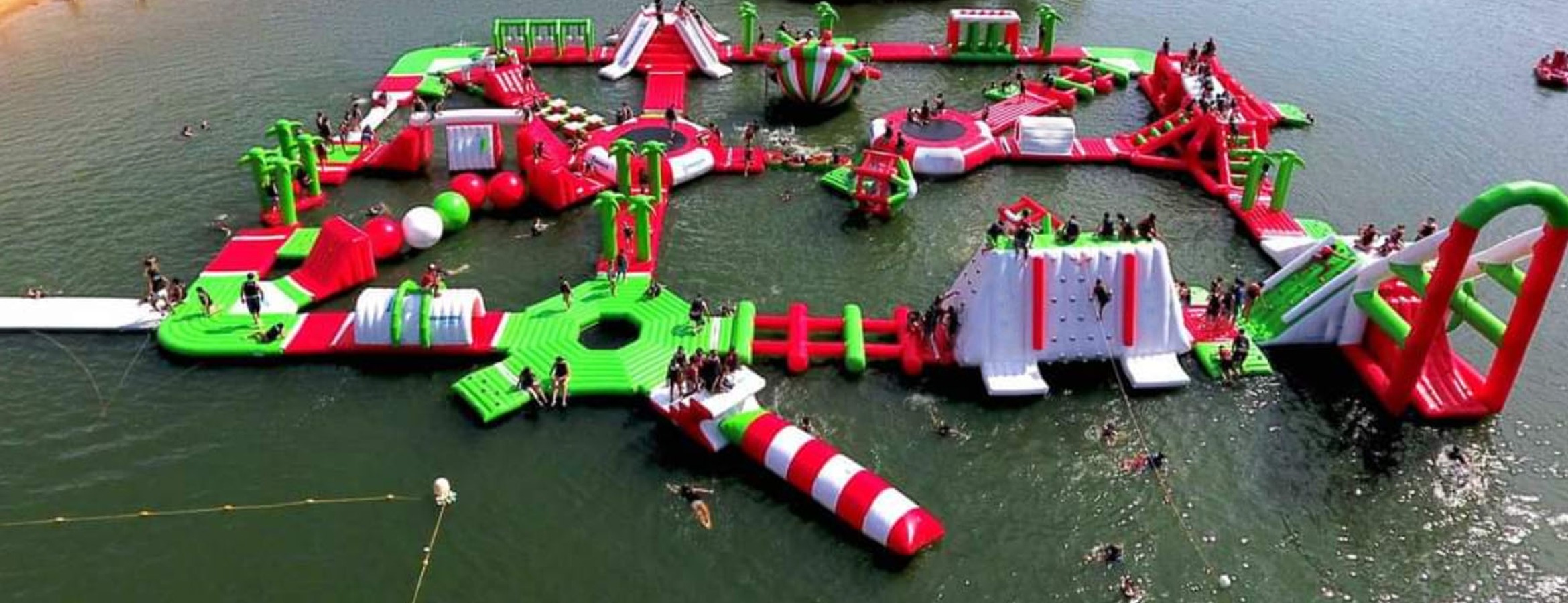
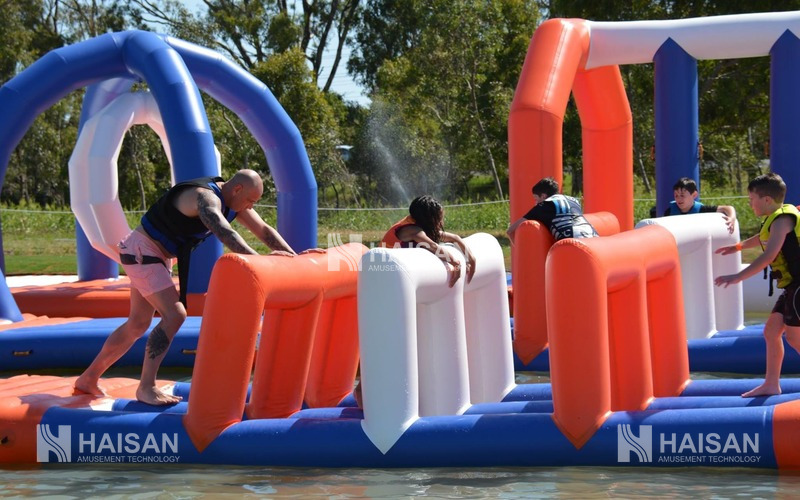
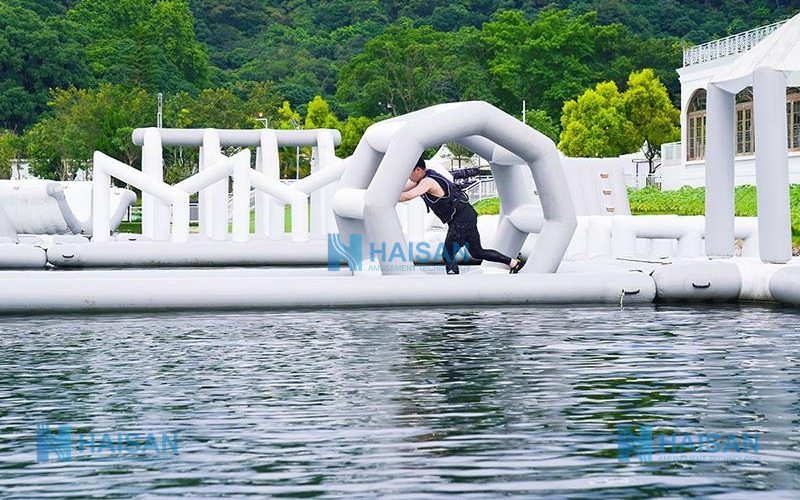
Modular inflatable obstacle course in 0.9 mm reinforced PVC, covering 300-3,000 m2 and holding 20-200 users simultaneously. Sealed-air construction, heat-welded seams and a stainless anchor system allow seasonal deployment in 2-4 hours.
floats and anchors; no pool shell, pump house or filtration loop required
one-way flow, rest platforms and lifeguard sightlines planned before modules are chosen
no stitching to wick water; high-wear sections upgraded to 1.0 mm
modules bolt on to an existing course without replacing it
An inflatable obstacle course is the fastest route to a new revenue line on water a park already owns. There is no civil work, no pump house and no filtration loop; the course floats, is anchored to the bed or bank, and can be deflated and stored at the end of the season. For resorts with a lake or a lagoon that currently serves only as scenery, it converts an unused asset into a ticketed attraction in a single procurement cycle.
Course Design Comes First
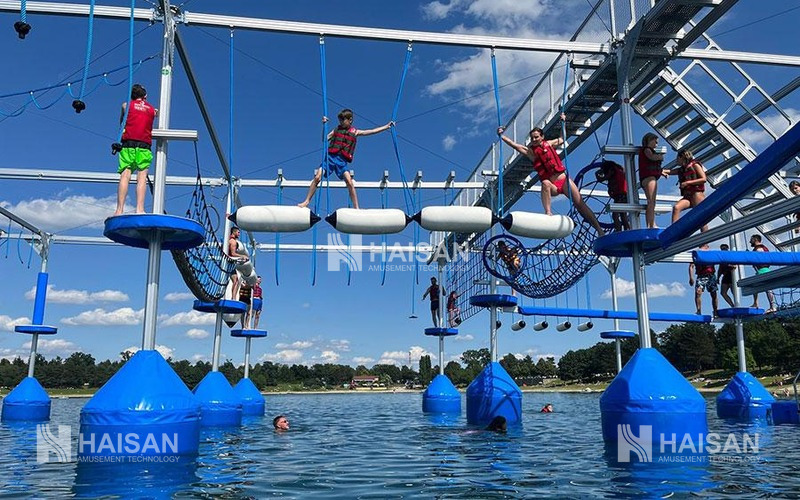
The mistake is to buy modules and then arrange them. A workable course is designed around three things: a one-way traffic flow so guests do not meet head-on, rest platforms placed so that weaker swimmers can drop out at any point, and a lifeguard sightline that covers the whole route from two or three positions. A typical beginner-to-advanced layout runs entry ramp, balance section, climb and slide, then a decision point where stronger guests continue to the advanced loop and everyone else exits. Modules are then selected to fit that route rather than the other way round.
Modules and Configuration
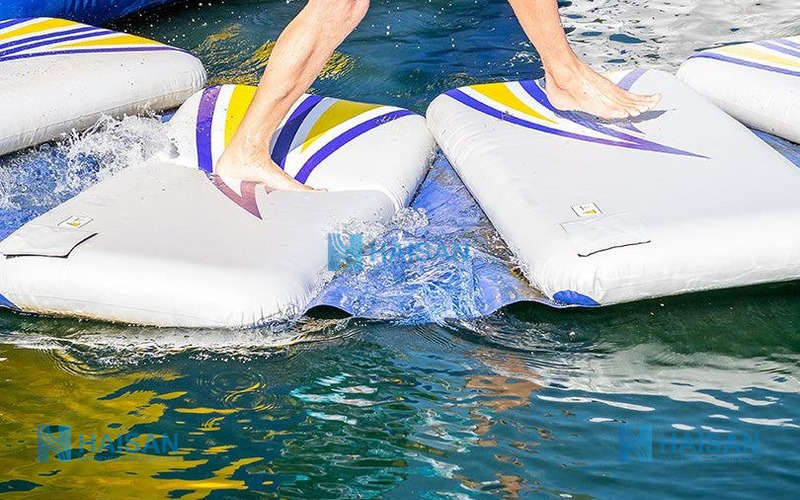
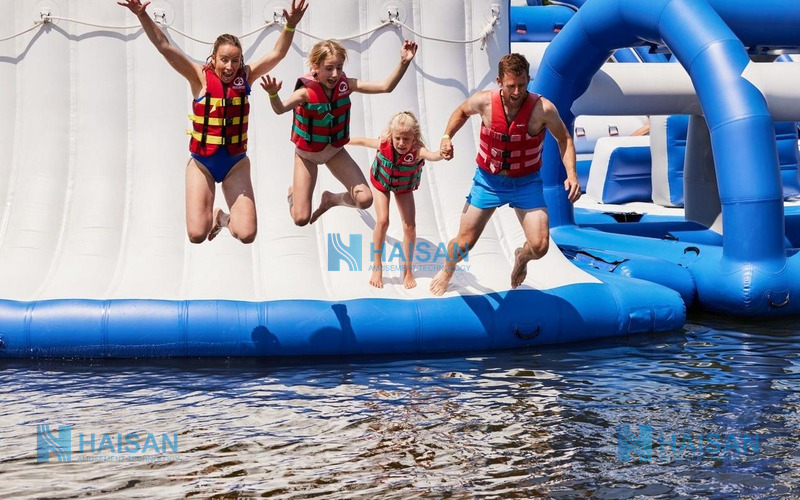
The standard module set covers runways, climbing ramps and walls, balance beams, stepping pads, circular and corner platforms, a dock access module and one or more slides; the slide is usually the tallest element and doubles as the visual anchor that sells the attraction from shore. Courses scale from a 300-600 m2 compact layout for a hotel beach to a 2,000-3,000 m2 ticketed park, and modules can be added in later seasons without replacing what is already there.
Materials and Construction
Floating modules are built from 0.9 mm reinforced PVC tarpaulin, with 1.0 mm or drop-stitch material on high-wear sections such as entry ramps and slide lips. Seams are heat-welded rather than sewn, because stitching creates needle holes that wick water into the air chamber; stress zones are double-reinforced and every connection uses stainless steel D-rings with replaceable straps. Walking surfaces carry an anti-slip texture and all edges are rounded, since the most common injury on these courses is a scraped shin at a module joint.
Anchoring and Water Conditions
Anchoring is site-specific and is the part most often under-engineered. Calm lakes usually take mooring lines to concrete blocks or helical anchors on the bed; tidal or moving water needs an engineered layout with elastic elements so the course can rise and fall without slackening. Recommended water depth is 1.5-2.5 m at the modules, with a clear swim-out zone and no submerged structures. Operation is suspended for lightning, high wind, poor visibility and any period when the water is carrying debris.
Operation and Lifesaving
Capacity is governed by supervision, not by the inflatable. The practical rule is one lifeguard per 60-80 simultaneous users, plus a dedicated entry controller who checks height, swim ability and life-jacket fit. Courses are supplied with a repair kit and a valve spanner, and the annual routine is a pressure check, a seam inspection and a patch programme at the end of each season. With that regime a commercial course typically returns three to five seasons of service before major module replacement.
To better serve you,please share your requirements,including the project's location,size, positioning, business type, and estimated opening date.