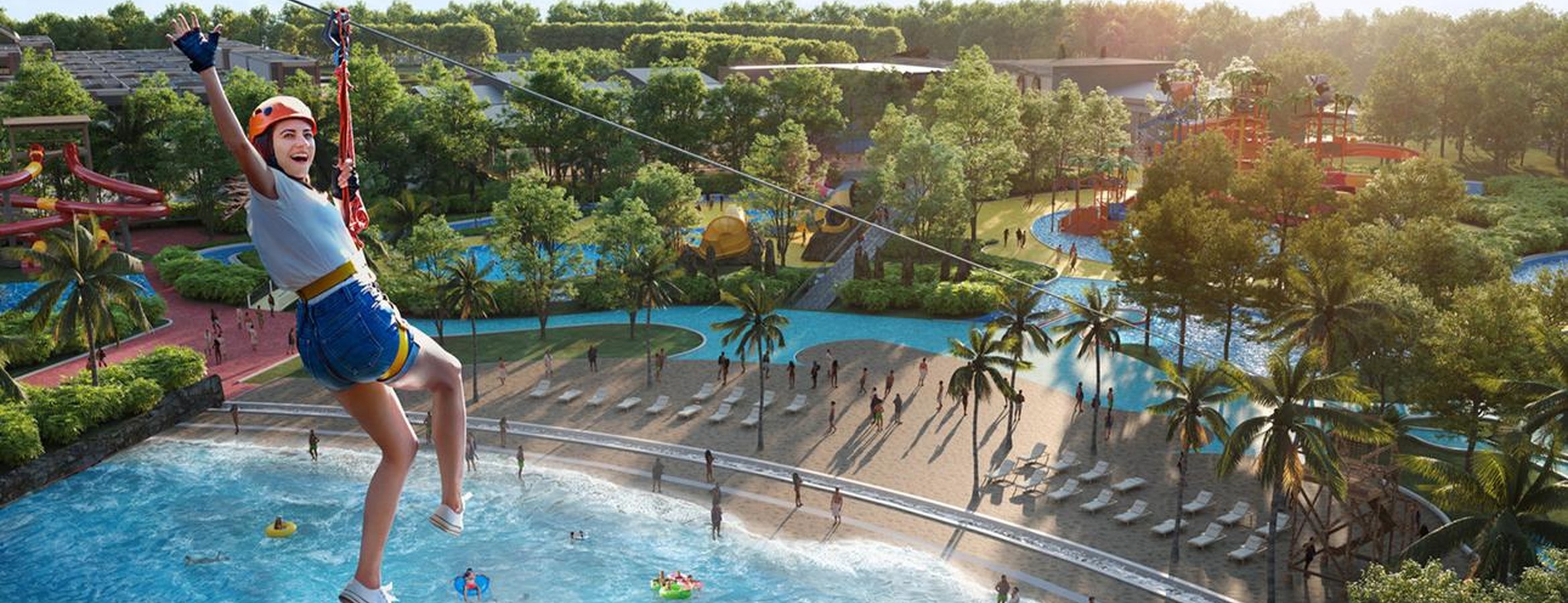
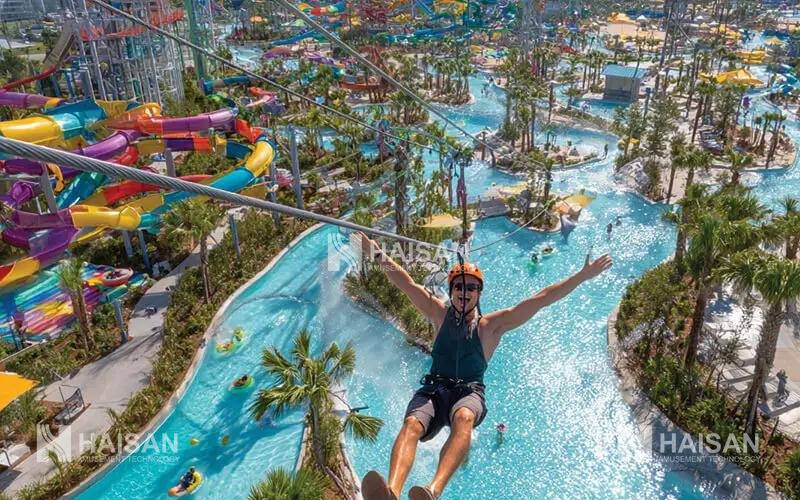
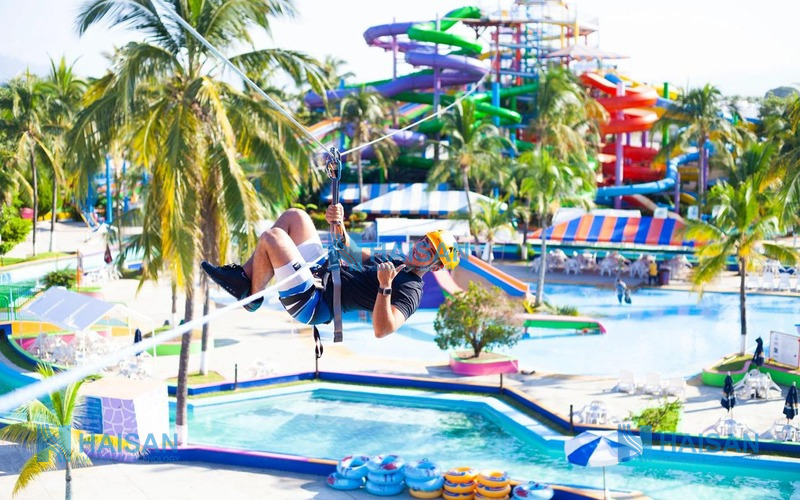
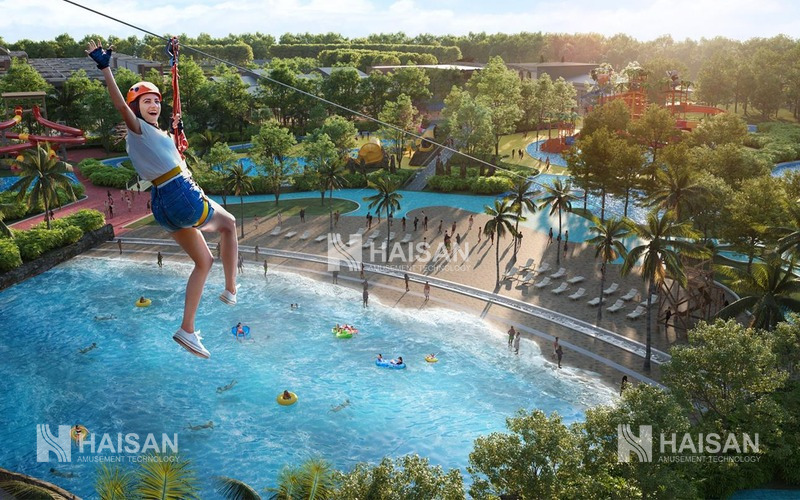
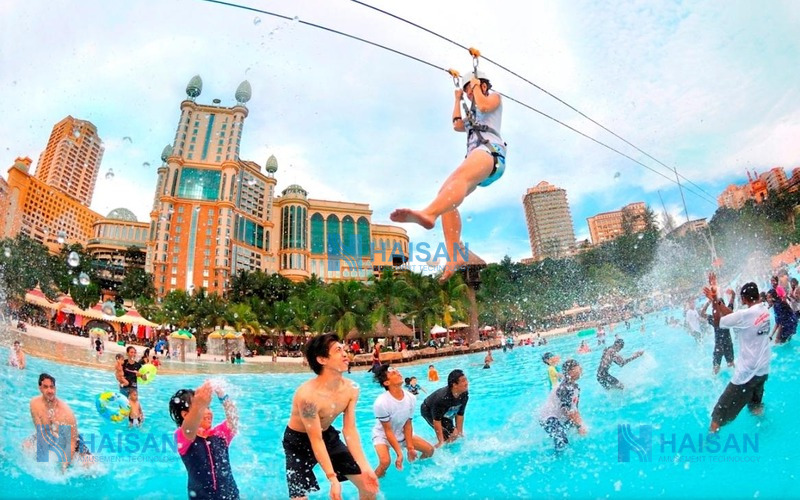
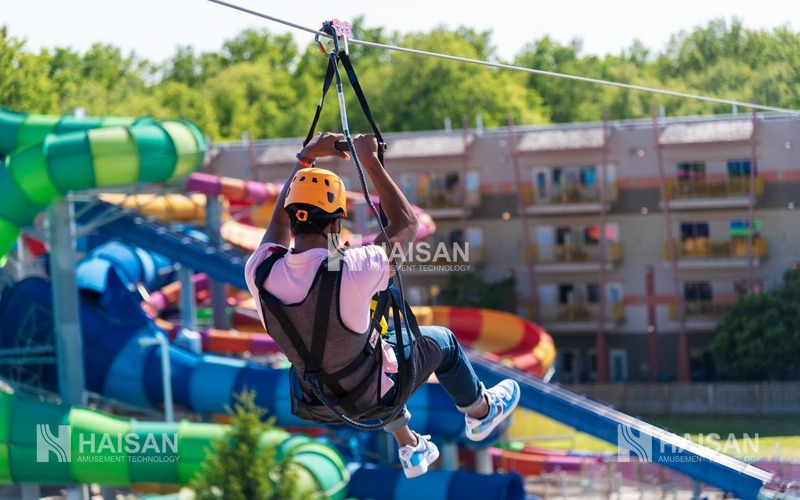
A dual-line zip line with 60-250 metre spans and 5-15 metre towers, dispatching up to 120 riders per hour per line. Riders launch from a themed tower and land on a raised or ground platform, with magnetic or bungee braking for a controlled stop.
no pumps, filtration or make-up water; gravity provides all the energy
two parallel cables turn a solo ride into a race and double hourly throughput
span the wave pool or lagoon and turn unused airspace into the park's landmark
magnetic braking holds a consistent stop across the full rider weight range
A zip line is the cheapest way to add a genuine thrill ride to a water park. It needs no water, no pumps and no filtration; gravity does the work. What it does need is height, a clear line and a controlled landing, which is why the engineering sits almost entirely in the towers, the cable and the braking system rather than in the ride itself.
Where a Zip Line Fits
The strongest placement is usually across the main wave pool, the lazy river or a central lagoon, because the ride becomes visible from most of the park and turns idle airspace into an attraction. A secondary placement is along the boundary of the site, where a long span can be achieved with a single tower at each end. In resort settings the line often runs from a hillside or an existing building roof down to the beach or pool deck, which removes the need for a launch tower altogether.
Towers and Cable System
Towers are hot-dip galvanized steel, bolted in modules and founded on reinforced concrete pads sized to the site's wind and soil conditions. Access stairs are enclosed to full height and the launch deck is sized for queuing plus one operator position. The cable is galvanized steel wire rope with a minimum breaking load calculated against a load factor of at least five times the combined rider and trolley weight; anchors and foundations are checked against the resulting horizontal thrust, which is the load case that most often governs the design.
Braking and Dispatch
Three braking approaches are available. Gravity braking relies on cable slope and a long run-out and is the simplest to maintain. Bungee braking absorbs the arrival with elastic elements and suits short spans with limited landing space. Magnetic braking is the most controlled option and holds a consistent deceleration across a wide rider-weight range, which matters where the guest mix includes children and adults on the same line. Dual lines are dispatched by a single operator using a red/green signal; interlocked dispatch prevents a second rider entering before the first has cleared.
Safety and Compliance
Commercial zip lines are designed to EN 15567-1/-2 or ASTM F2959, with ACCT practice followed for operating procedures. Haisan supplies the structural calculations, anchor details and commissioning records needed for local authority acceptance and insurance review. Rider limits are set by harness capacity and braking envelope rather than by age alone: typically 25-120 kg with a minimum height of 1.2 m, and a full-body harness with a redundant attachment point. Daily pre-opening checks cover trolley wheels, harness stitching, cable tension and the landing zone.
Operation and Staffing
A single-line installation runs with one operator at the top and one marshal at the landing, and the same two staff can supervise a dual-line race. Because the ride is weather-sensitive, the operating plan needs a wind-speed cut-off and a lightning protocol; both are written into the handover documentation. Maintenance is limited to cable inspection, trolley bearing replacement and annual third-party NDT of anchors, which keeps the whole-life cost well below that of a water ride.
To better serve you,please share your requirements,including the project's location,size, positioning, business type, and estimated opening date.